
"Students don't care how much you know until they know how much you care."
- John C. Maxwell
C A R I N G
Students' learning needs are paramount to a productive and engaging classroom, as students cannot learn well without their needs being met beforehand. Maslow's Hierarchy of Needs specifically illustrates this, as does common sense! Below are a few ways I try to assist students with their needs, from flexible seating options, posted schedules for curbing anxiety, fidget tools for students with ADHD, and a class rug area that – surprisingly – is a student favorite for hanging out and reading texts aloud.


Two areas of the classroom are dedicated to the time of day, the daily schedule, and a calendar that provides a monthly snapshot of upcoming important dates to remember. These are visible for students who have specific appointment times for visiting the nurse, or for students who become anxious without knowing the day's schedule or important dates.
Student small group areas are provided for preferential seating as well as for more structured small group times. Students will often ask to sit alone to focus better on their work at the small group table, and are usually welcome to do so. The small group table also has dry-erase circles for working with students to decode words, morphemes, and other phonics activities.
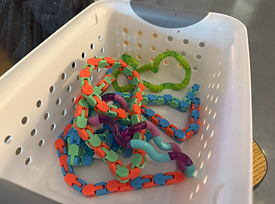
Students with ADHD and hyperactivity issues are also welcome to utilize the classroom fidget tools with the understanding that if the fidget "tool" turns into a "toy," it will be removed from their use for the day. Students have demonstrated the usefulness of these tools throughout the first nine weeks of the school year already, relying on them for focusing on work while having something they can manipulate to provide bodily coordination.
Students also highly value the privilege of the classroom couch, bungee cord chair, and classroom rug area. They enjoy using these areas for independent work and group work, and are aware that misuse of the areas or displacement of the area's blankets and pillows are reason for restriction to accessing the area.
Students specifically have shown more engagement for passage read-alouds when asked to sit around the class rug, as it focuses them and eliminates distractions outside of the story being read aloud.
Lastly, while not pictured, the classroom is normally lit with outdoor string lighting and tabletop lamps instead of the provided fluorescent lighting. Unanimous voting of student preferences indicated that this lighting method is the preference, as the fluorescent lighting isn't enjoyed by many – teacher included!
Other methods for communicating caring include providing extra headphone sets for students who value having assigned texts read aloud to them as they follow along, as well as providing soothing soft drinks for a student with high testing anxiety to settle their stomach before the assessment. A classroom library with high-interest books is also provided and consistently used. It is my hope that with these classroom features, I communicate to students how their learning experiences are valued and cared for within the Hopper Reading Room.