
"Accommodations are not extras, they are equity." - Becca Lory Hector
E Q U A L I T Y
Differentiation is not just necessary; it's a vital way to connect with students and meet them where they are. This practice in the classroom inspires students to remain engaged in the content instead of detaching due to a lack of interest or understanding. Differentiation also communicates to students that they are expected to participate in classroom discussions and activities, and that they should be contributing to the classroom as comparable to their peers.
In the Hopper Reading Room, differentiation promotes equality mostly through automated processes. Our anchor curriculum, Amplify CKLA, provides automatic differentiation, as do some of our supplementary materials that we use for remediation and demonstration of understanding.
AMPLIFY DIFFERENTIATION
Amplify CKLA is our main curriculum within the Hopper Reading Room, and students are currently enjoying learning about the author Roald Dahl's own childhood experiences through his memoir, Boy. Students are given a number of activities to complete for classwork within the digital curriculum platform, and Amplify allows for automated differentiation based on learner levels and needs.
For example, students in the first and second block classes of the day need less differentiation than the third and fourth blocks of the day. Amplify can scaffold activities assigned to the class as a whole based on a pre-sorting of student learning needs.
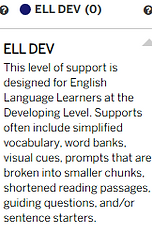
AMPLIFY DIFFERENTIATION KEY & SYMBOLS



1ST BLOCK CLASS
The first block class includes largely learners who are on pace with 6th-grade expectations, with a few students who need a little more scaffolding to support their understanding of more complex concepts. These students are represented by the Light and Moderate differentiation sections, as they demonstrate understanding of several concepts, but benefit from supports like sentence starters and simplified language within instruction. The first block class also recently welcomed an ESOL student who speaks very little English, who is represented in the ELL Dev section to assist with their growth in understanding as we work with them throughout the school year. Lastly, three students who have demonstrated a mastery of complex concepts and grasp new information quickly and accurately are given activities framed in a more challenging manner so as to meet their learning paces as well.
2ND BLOCK CLASS

The second block class also largely includes learners who are on pace with 6th-grade expectations, with a few students who need a little more scaffolding to support their understanding of more complex concepts. These students are represented by the Light and Moderate differentiation sections, as they demonstrate understanding of several concepts, but benefit from supports like sentence starters and simplified language within instruction. This block class includes four students who consistently demonstrate a mastery of complex concepts and grasp new information quickly and accurately are given activities framed in a more challenging manner so as to meet their learning paces as well.
3RD BLOCK CLASS

The third block class also largely includes learners who are on pace with 6th-grade expectations, but is the first of two SPED inclusion classes of the school day. Students who are enrolled in special education classes also have various learning needs, such as preferential seating, testing accommodations, and more, along with an understanding of their learning levels. These students are represented within the Substantial differentiation section, as they include readers with learning disabilities as well as readers well below a 6th-grade reading level. Students represented by the Light and Moderate differentiation sections are enrolled in Tier Academic support, as they demonstrate understanding of concepts, but benefit from supports like sentence starters and simplified language within instruction.
4TH BLOCK CLASS

The fourth block class also largely includes learners who are on pace with 6th-grade expectations, and is the last of two SPED inclusion classes of the school day. Students who are enrolled in special education classes also have various learning needs, such as preferential seating, testing accommodations, and more, along with an understanding of their learning levels. These students are represented within the Substantial differentiation section, as they include readers with learning disabilities as well as readers well below a 6th-grade reading level. Students represented by the Light and Moderate differentiation sections are enrolled in Tier Academic support, as they demonstrate understanding of concepts, but benefit from supports like sentence starters and simplified language within instruction. Three students in this class consistently demonstrate a mastery of complex concepts and grasp new information quickly and accurately, and are given activities framed in a more challenging manner so as to meet their learning paces as well.
SUPPLEMENTARY DIFFERENTIATION
Differentiation is also applied to supplementary instructional materials used, including assigned IXL.com skills for students to study for homework and/or early finisher activities and Scholastic's SCOPE Literature Magazine resources.

Students who demonstrate an understanding or mastery of most concepts are expected to achieve mastery of any assigned IXL skills. This is represented by a reminder for students on the right-hand side of their screens while practicing that they are to hit a 'Smart Score' of 100. For students who require more support and scaffolding to understand 6th-grade concepts and reading passages, they are expected to demonstrate proficiency in any assigned IXL skill. These students are reminded of this goal on the right-hand side of their screens while practicing that they are to hit a 'Smart Score' of 90. Lastly, for students enrolled in special education or TIER for academic support, they are expected to achieve excellence in any assigned IXL skills. These students are reminded of this goal on the right-hand side of their screens that they are to hit a 'Smart Score' of either 70 or 80.
IXL skills receive less specific differentiation compared to Amplify, as it is not our main curriculum and it also embeds several support features within the students' practice screens, regardless of level. Students can watch a video to clarify any questions, ask for several examples, and can continue to practice regardless of incorrect answers to reach their goal.
Scholastic's SCOPE Literature Magazine resources include a wide range of tools for differentiation, including digital issues for student engagement that allow students to have articles read aloud to them. The resources also include identified Lexile levels for instructors, as well as scaffolded graphic organizers and graphic organizers with less support. In addition to these features, SCOPE provides two levels to work with for students who are demonstrating an understanding of 6th-grade concepts and for students who demonstrate a need for further support. These resources are used periodically within each block class to check for understanding and comprehension, and to further understand complex MSCCR Standards, such as writing or reading informational texts standards.
SCOPE's On-Level Formative Assessment Label

SCOPE's Needs Support Formative Assessment Label

Example of SCOPE's On-Level Formative Assessment Essay Question

Example of SCOPE's Needs Support Formative Assessment Essay Question

ASSESSMENT DIFFERENTIATION
For teacher-created assessments, differentiation is provided through alteration of assessment requirements to meet students at their learning levels. For example, the summative assessment on Theme and Central idea utilized two passages from a sample standardized test for students to analyze to identify the theme of the passages. Subtle alterations to the passages occurred, only eliminating vocabulary that was sure to cause confusion. The words removed were carefully selected so as to prevent any change in meaning from the text. In addition, the constructed response question of the test was limited by the number of required sentences for students enrolled in special education and TIER to prevent testing burnout. The test questions described above are shown below with the on-level passages followed by the limited passages, as well as the on-level questions followed by the limited questions.